The Thark attack on the Helium expedition
A Princess of MarsThe Thark attack on the Helium expedition is both a devastating ambush and the event that brings Dejah Thoris into John Carter’s life. When twenty Red Martian airships approach a city held by Green Martians, the Tharks answer with a sudden, carefully directed barrage that breaks the fleet’s advance. One damaged vessel cannot escape and drifts back to the ground. Its dead crew and surviving captive reveal that the attack has reached beyond a clash of weapons: it has delivered a political prisoner whose scientific mission, as she later explains, was meant to sustain life on Mars.
The Fleet’s Arrival and the Thark Response
The confrontation begins on the third day after the incubator ceremony, as the Green Martians set out toward home. Before the procession has fully emerged from the city, orders send it hastily back. The warriors, chariots, and mastodons disappear into nearby buildings in less than three minutes, a practiced withdrawal that leaves the open ground empty. From an upper-floor window, John Carter and Sola see what has prompted it: one gray airship sails over a nearby hill, followed by nineteen more, all low and slow-moving toward the city.
The ships display banners above their upper works and devices painted on their prows; figures crowd their forward decks. Carter cannot tell whether the crews have discovered the Green Martians or are simply observing the deserted city. The Tharks do not wait to find out. Warriors in buildings facing the valley open fire without warning, turning the ships’ peaceful-looking approach into a battle.
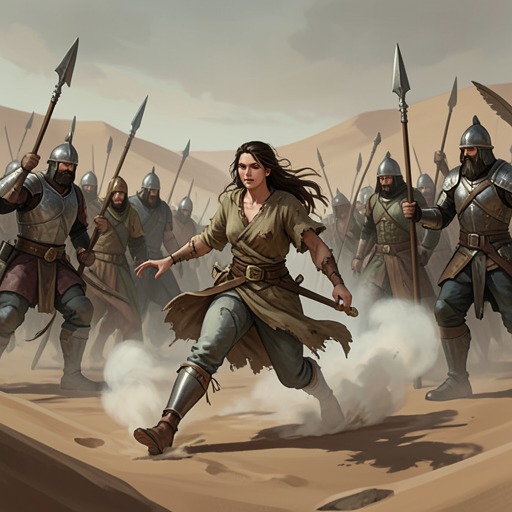
The leading vessel swings broadside and returns fire with its guns, moving along the Green Martian front before turning to make another pass. The other craft follow, each opening fire as it reaches position. The Thark volley, however, has already disrupted the attackers. Carter sees the Green Martians shoot with extraordinary accuracy: figures fall from the decks, while banners and upper works erupt under the impacts. Their fire is not merely a broadside exchange but a deliberate effort to disable the fleet’s capacity to fight.
A Coordinated Defeat
The Green Martians divide their fire among specific targets. Their best marksmen concentrate on the wireless finding and sighting equipment that directs the large guns; other groups attack the smaller guns, gunners, officers, crew, steering gear, propellers, and upper works. This distribution of targets helps explain why the ships’ return fire proves ineffective: the initial volley catches their crews unprepared and their guns’ sighting apparatus exposed. The attack’s effectiveness lies not only in the weapons but in the Tharks’ disciplined assignment of aims.
Twenty minutes after the first volley, the fleet turns away. Several ships limp under the control of depleted crews, and their guns fall silent as they concentrate on escaping. The Green Martians rush to the roofs and continue firing after the retreating craft. One by one, the ships dip below the distant hills; the last remains barely in sight, moving so slowly that it appears almost unmanned.
That vessel has borne the brunt of the attack. It veers back toward the city in an erratic circle, apparently unable either to fight or to steer itself clear. The Tharks cease firing once its helplessness becomes clear. Carter can see bodies scattered across its decks but cannot identify the crew. The ship drifts about fifty feet above the ground, while most of the warriors pursue it and roughly a hundred remain behind on the roofs in case the fleet returns or reinforcements arrive.
The Wreck and Its Captive
The drifting airship is on course to strike buildings about a mile south of Carter’s position. Some Green Martians ride ahead, dismount, and enter the building the craft is likely to hit. Just before impact, warriors swarm onto the vessel through its windows and use their spears to ease the collision. They then throw out grappling hooks, and others haul the large ship down to the ground. The capture of the vessel converts the retreating fleet’s final crippled craft into a prize for its attackers.
Once the airship is secured, the Green Martians search it from stem to stern. They examine the dead sailors for signs of life and bring up a small, living figure from below. The captive is less than half the height of a Green Martian warrior and walks upright on two legs. From his distant vantage, Carter first mistakes the prisoner for an unfamiliar Martian creature; he has not yet understood that she is a person from the expedition’s opposing civilization.
The warriors remove the captive and systematically strip the ship of its contents. The recovered goods include arms and ammunition, silks and furs, jewels, carved stone vessels, food, and liquids. Among the stores are casks of water, the first Carter has seen since arriving on Mars. The salvaging takes several hours and requires chariots to carry away the loot. Afterward, the warriors tow the airship out into the valley and appear to pour the contents of carboys over the bodies and the vessel’s decks and upper works.
Dejah Thoris and the Encounter’s Turn
The attack has consequences beyond the battlefield. The danger of another strike keeps the Green Martian caravan at the deserted city; Lorquas Ptomel, wary of exposing chariots and children on the open plain, delays the homeward march for more than a week. When Carter and Sola later enter the plaza, he sees the captive being dragged into a nearby building by two Green Martian females. His response is a mixture of hope, fear, exultation, and depression, with relief and happiness strongest: he recognizes in her a slender, girlish figure like the women of his former life on Earth.
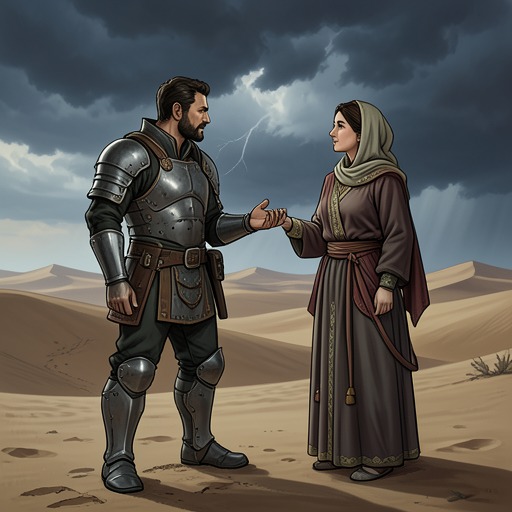
The prisoner is Dejah Thoris, daughter of Mors Kajak of Helium. As she is taken through the doorway that will serve as her prison, she turns and meets Carter’s eyes. She makes a small sign with her free hand, and hope briefly brightens her face. Carter does not understand the gesture or answer it. Only after she has been dragged from sight does he realize that she had appealed for help and protection. Her hope gives way to dejection, mingled with contempt for the man who appeared not to respond. The battle has thus brought them face to face, but his ignorance of Martian custom prevents their first meeting from becoming a rescue.
The Mission Behind the Battle
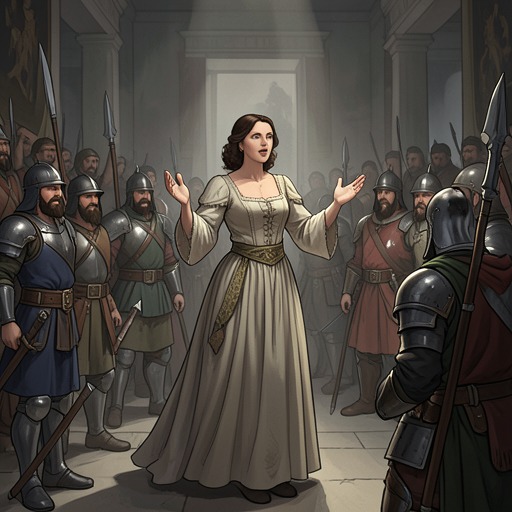
When Dejah Thoris explains her identity and expedition, the capture acquires a larger significance. She says the party was sent by her grandfather, the Jeddak of Helium, on a scientific mission to rechart air currents and measure atmospheric density. The airships’ peaceful colors and banners, she says, had marked their purpose; the expedition was unprepared for battle. Her account frames the engagement as an attack on researchers as well as a military defeat for Helium.
Dejah Thoris argues that the expedition’s work benefits the Green Martians too. She says that the research and its results help maintain the air and water supply without appreciable loss, and warns that Mars cannot support human life without that work. Her appeal contrasts the Red Martians’ technical stewardship with the Green Martians’ communal society, which she condemns as cruel and lacking homes, art, written language, and love. She urges them toward amity and cooperation, offering the aid of the Red Martians in the effort to regenerate a dying planet. The captured airship therefore carries more than weapons and a prisoner: the encounter exposes the conflict between the Martian peoples and the possibility, asserted by Dejah Thoris, that their survival depends on cooperation.
The technological setting sharpens the stakes. Earlier, Carter had learned that the Green Martians’ rifles use small, explosive radium projectiles and can be effective at extraordinary range: their theoretical radius is three hundred miles, though their practical reach with wireless finders and sights is a little over two hundred. In the battle, the ships’ guns and the Tharks’ targeted fire make weaponry and sighting systems central to the outcome. Later, Carter learns that Mars’s artificial atmosphere depends on the ninth ray, separated from sunlight and processed before being pumped to the planet’s air centers; the enormous plant has a thousand-year reserve, but its operation remains vulnerable to failure. When word eventually reaches the governments that the plant’s assistant keeper has been found murdered and that the engine has stopped, the earlier scientific mission’s concern with atmospheric conditions gains urgent force. The battle does not itself cause that later crisis, but it introduces Dejah Thoris and her expedition’s work into a story in which the planet’s life-support systems become a matter of immediate survival.